Riga Travel Blog - Part III - Road Trip from Riga
Recap - Useful Information
Here is the link to Part I of the blog - https://harshad-datar.blogspot.com/2020/12/riga-largest-baltic-city-part-i-riga.html
Here is the link to Part I of the blog - https://harshad-datar.blogspot.com/2021/01/riga-largest-city-in-baltics-part-ii.html
Introduction.
Riga is the capital city of the Baltic state of Latvia. It also is the biggest Baltic City with about 7 Lakh population. Some interesting statistics are, Riga is home to 1/3 of Latvia’s and 1/10 of total Baltics States’ compound population.
Situated at the Gulf of Riga, at the mouth of Daugava river on Baltics Sea. Riga is almost the same age as Tallinn. This city was founded in 1201 AD. IN its long existence, Riga has seen rules of Sweden, Germany, Russia, USSR, etc. till Latvia achieved its independence from USSR in 1990.
Riga of today is a modern city generation about 50 % of Latvia’s GDP. It is a major Baltic Port and the main gateway for the export of wood, Software, Metallurgy, etc.
How to Reach.
Riga is a well-connected city. It has flights coming from over 80 countries which come to Riga International Airport.
It can be reached by sea from Germany and Scandinavian Countries. It has rail connect with Moscow and St Petersburg in Russia. It is well connected by highway network and bus services operate between all three Baltic States. Bus presents a low-cost option for travel across Baltics. Most buses in Europe ate Volvo kind of airconditioned and comfortable ones with a toilet and some service providers also provide hot tea and coffee during the journey.
Stay Options.
Riga gets over 3.5 million visitors a year. With that kind of influx of the visitors, the stay options available are plenty. They meet the need for all types of travellers with the rentals that they can afford. There are a variety of hotels, highly rated hostels and B & Bs. There are small boutique hotels in and close to the old city, mostly in old historical buildings. A hotel in which we stayed was in an over 100-year-old building with real wood furniture. It was beautiful and it was very close to the Old city.
Local Travel.
Riga has plentiful public transport. There is also an option of hiring Cras and Bicycles. However, for all the sights mentioned below, except for Day trip, no transport is needed. All these places are convenient to walk and the walks are pleasant in Riga with the places to visit and parks, small and big are intermingled. My recommendation is to walk but for those who can not, there is public transport.
Day
Trip from Riga
The places visited -
1. Salaspils Concentration Camp Memorial
2. Rundale Palace
3. Hill of Crosses (in Lithuania)
4. Kemeri National Park and Bogs
5. Jurmala (Covered in the blog but not visited)
Our third
day at Riga was kept for a road trip around Riga. We hired a car through our
hotel from a local car hirer. It was a Hatchback with a seating capacity of 5 but
not much luggage space (that was ok. One does not need luggage space for a day
trip). The car had a manual transmission.
The car was
in good condition. After signing the documents and mentioning to the
representative of the hirer that we will go up to Hill of Crosses in Lithuania (a
neighbour country) we were all set to go. On our return, we realized that it was
necessary to enter the fact that we would travel to another country (and back)
in to the agreement. The company claimed that we need to pay fine as we did not
disclose that we will cross the border but after explaining that their
executive was told, they agreed no to take fine from us.
I have put
a blog giving all the Do's and Don’ts of hiring a car, especially abroad. It can
be read here – https://harshad-datar.blogspot.com/2019/07/renting-car-for-road-trip-in-europe-and.html.
Here is the map of our drive from Riga to various sites and back to Riga.
 |
| The Map of this Drive |
We started
from Riga around 9 am. Our departure got delayed due to late arrival of the hired
car. We took off and used mobile-based navigation because the car did not have a navigation system. First stop was just 20 Km. It was Salaspil Memorial, created
in memory of prisoners who died in Salaspils Concentration Camp created by
Nazis.
Salaspils
Memorial
As a human
being, it breaks one's heart when one visits the Tower of Skulls in Cambodia (where
thousand Skulls of victims of a despot
communist ruler Polpot is preserved) or a concentration camps in and around
Germany. One wonders how and why tortures were inflected by some on their
fellow human beings.
Salaspils
was one such concentration camp some 20 km outside Riga, near the town of
Salaspils by occupying Germans in the year 1941. It is, in one sense (some
solace) not a concentration camp where people were exterminated by Gas Chambers.
It was a prison to house Russian Prisoners of War (POW), leaders of local
resistance and Latvian, Russian, German and other Jews scheduled for further transit to main Concentration Camps.
At various times there were about 20 thousand prisoners in Salaspils. Among the
prisoners of all kind, there were many children who suffered the worst fate.
This
Salaspils Memorial Ensemble was erected in memorial of those 2000 people who
died in this camp and also in other places. This memorial opened in 1967. It
has a symbol of the border between Life and Death. It is a 100 m long concrete box inside which there an exhibition of photographs and other details of life in
Salspil Jail and Correction Center. There are Seven very moving concrete sculptured
titled “Mother”, The Unbroken. The Humulited, Protest, Red Front, Solidarity
and The Oath. The wall (concrete box) has very poignant words written on it,
they are “Beyond these gates the land groans”.
 |
Memorial Wall - It reads "Beyond these gates the land groans"
|
 |
| The Statues are in the background |
 |
| Statues depicting the Jailed and their resistance |
 |
| Memorial for the Children victims and the respect people have paid to their souls |
 |
| Humiliated |
 |
| Three of them, from L to R, Solidarity, The Oath and Red Front |
 |
| The Mother |
 |
| The Unbroken |
Set amid
forested area, created in a creative way, this memorial should be included in a
place worth visit, to pray for those unfortunate souls who have to endure much
pain and suffering and to pray to supreme power to never endure such things on Mankind.
Rundale
Palace and Museum
After
spending some time at Salaspil Memorial and praying for the unfortunate souls
who died here and elsewhere, we started our journey for Rundale Palace, about
70 km from Salaspils Memorial. While we were on the road, we did not have much
idea s to what to expect there. What we knew was that the gardens of Rundale Place
were supposed to be good.
When we
reached Rundale Palace, its scale was mesmerizing. After buying tickets for the
Gardens, we entered the premise. Grand was the word for the gardens themselves.
The palace also looked grand but we were short of time to visit the palace and
the museum.
While for
the sake of completeness and blog writers duty, I will give researched
information about the palace, however, the description of the Gardens is out of
personal experience.
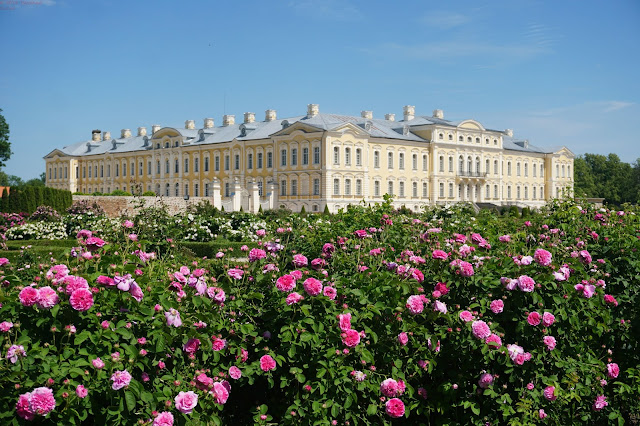
Rundale
Palace was constructed in two phases from 1736 to 1738 as a family home to the
Duke of Courland, a vassal of the Russian Empire with many independent rights as
Count. The partial independence made the count administer his area and that
made him rich out of taxation, etc This rich Duke made two grand Baroque style
palaces, Rundale was one of those two palaces. It had been Duke’s Summer Palace,
being less important compared to Jelgava Palace, the other Baroque-style
palace.
This palace
is not as big as Versailles or other European palaces, none the less, this is
a charming palace having two wings, Eats and west, which house the official
areas (formal areas) and private residential area respectively. 40 of the 138
rooms of this palace are open for visitors.
This 14249 Sqm,
16 building palace spread over 43 hectors (out of the total area of 85 hectors,
rest are garden and forest) has seen many ups and downs during its over 250
years of history. It has been used for many other purposes including Military
headquarter, school, hospital, etc. It has been painstakingly restored since
1972 and some work is still going on.
Hallmark of
the palace (like many other castles and palaces in Europe) is the French Garden.
No Baroque Style palace is complete without a well laid out garden and the
garden of Rundale Palace confirm that fact.
The Franch
Garden, spread over 10 hectors, consists of Ornamental Pattern garden, Rose Garden,
Green Ampitheater and fountains. If it is to be experienced properly, one
would need at least 1 hour 30 minutes. Now, instead of talking more about the
Gardens, let me take you on a photo tour of Rundale Palace Gardens.
 |
| Rundale Palace |
 |
| Rose Garden, Rundale Palace in the Background |
 |
| Geometrical Pattern Crystal Maze |
 |
| A Water Fountain |
 |
| Tree Line |
 |
| Green Amphitheatre |
 |
| Another Look |
 |
| Majestic Rose Garden |
 |
| Beautiful Ornamental Pattern |
The Palace, Fountain in the Foreground
The drive to Hill of Crosses
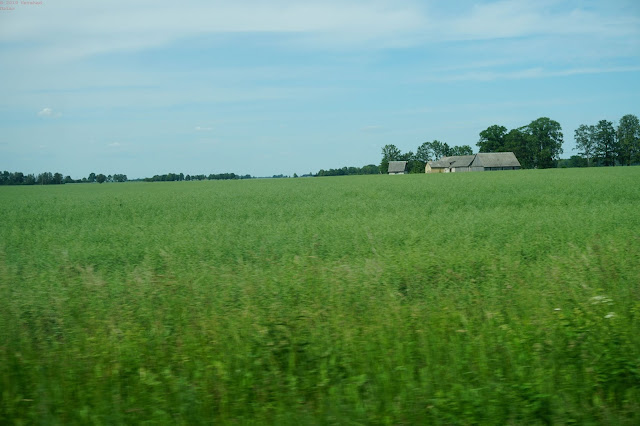
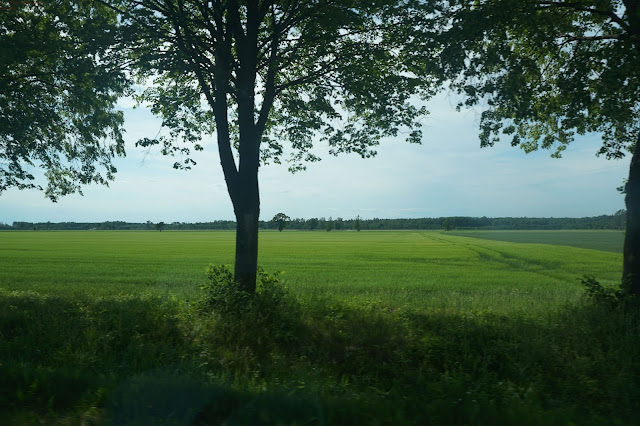
This place, Hill of Crosses, is about km fro Rundale Palace. The road is very good and very scenic. It is mostly two-lane but the traffic is thin. Enjoy the drive till we reach the destination.
 |
Green Countryside
|
 |
One More
|
 |
Busy Driving the Car
|
 |
Good Road, No Traffic
|
 |
Fields Glore
|
 |
| Wild Flowers |
Hill of Crosses
We have seen
crosses in Churches, Cemeteries and some other place. There may be one cross
or a few crosses, maybe one hundred,
maybe 500. If I tell you about a place in Lithuania, a neighbouring Baltic
state, which has not one, not 100, not 1000 but a place full of Crosses, over
200000 and counting, what would be your reaction?
That place
is Hill of Crosses, a famous place of pilgrimage in Lithuania, just across from
Latvia. This place needs to be seen to be believed.
As
believed, Crosses started on this hill in 1831 when during the uprising against the rule resulted in many deaths where the relatives were unable to find bodies of
their near and dear ones. As a symbolic ritual in place of burial, they seem to
have left crosses in their memory.
Another
legend has it that a Lithuanian farmer, whose daughter was seriously ill had a dream, where a lady asked him to plant a cross on this hill and pray for the recovery of his daughter. It is said
that after he followed what was said in the dream and planted a cross, his daughter recovered. This belief that the prayers get answered if a cross is placed on this hill and prayer for recovery is made here, making this place a place of
prayer to seek blessing.
Whatever
may the origin of the Crosses on this hill, the fact is, people believe in the
legends. The size, shapes and decoration on the crosses are good. Since
traditionally the crosses are wooden, most of them are carved and the carving
could really be intricate and beautiful.
This hill
was demolished twice by Soviets during their occupation but the Lethunian’s belief was so
strong that they braved soviets, KGB, etc to go and plant crosses on this hill.
Most notable cross here is a statue of Jesus Christ under a roof.
One must
visit this place when on a trip to Baltics. It is a mesmerizing place but it
could be overpowering too because such a
huge number of crosses can be overwhelming for few. Let the photos take you on
this trip-
 |
| Look!!!!! |
 |
| Stone Cross |
 |
| Can not believe my eyes |
 |
| Oh Jesus! |
 |
| All sizes |
 |
| Wooden, Metal or any other, a cross is a cross |
 |
| Beautiful |
 |
| Have you ever walked in the midst of so many crosses? |
 |
| Faith and Belief |
 |
| Scary |
 |
| Parting Shot |
Kemeri
National Park and Bogs
Bogs are
essentially wetlands where the water is acidic in nature. The plants and
vegetation that grow here are special as they can survive in Acidic water. Such bogs are
found in cold countries were vegetation growth rate in the bogs is low and the decay of plant and
animal material is even lower. Most of the bogs are over 12000 years old. The
decaying vegetation becomes Peat, an essential energy source for burning. Peat
is used in industries, homes for heating and distilleries.
10 % of
Latvia’s surface is covered by Bogs and Latvia is one of the major supplier of
peat across Europe. As for Kemeri Bogs and National Park, it has forests, lakes
and mires also called bogs. Ths park also has hot springs and sulfur baths. There
are many treks for the walkers. However, when it comes to bogs, one has to be
careful. To experience bogs, walking trails made of wooden planks have been
made over the bogs and one must stick to those trails only. The bogs are dangerous,
deep and unpredictable. Hence only a wooden boardwalk is recommended if bogs are
to be experienced. It is said that a few German tanks were swallowed by these
bogs during WW II.
Visiting
Kemeri National Park and enjoying it to the full would be at least a days
activity if not more. In our case, we had a short time and it was already nearing
sunset. We, therefore, did only the famous Bord Walk and enjoyed the Bogs,
nature, birds and vegetation and a wonderful sunset. Here are a few photos -
 |
| Wow Nature |
 |
| Boardwalk |
 |
| Beauty in the Wilderness |
 |
| Leaving Boardwalk is unsafe |
Jurmala
We had to
skip Jurmala during our trip as it had become very late in the evening.
However, I am covering Jurmala for completeness of the information in the
Blog.
Jurmala is
the only official resort town of Latvia. It has everything a resort town needs,
white sandy pristine beach spreading 25 km in length. The town also has
curative Mud bath spas, Mineral water and also Pine forests to boost.
This town
also has an open-air museum depicting what Jurmala a few years ago (decades). A
fishing village. The town has historical wooded Architecture, a water park, a
great concert hall and a typical small-town market.
The town is
worth spending time but it somehow did not fit in our programme.
With this
road trip, we have finished our virtual trip of Riga, Latvia. We had a grand time
over these four nights that we have spent here.
In the next
blog, we will embark on Loire Valley road trip in France, going from Paris,
through many castle towns to Mont St Michel and back.


