Showing posts with label Nation. Show all posts

Thursday, March 7, 2019

Strategic Impact of Kra Canal – Will there be a Financial Impact on Malacca Strait Nations

I am back again on the topic of the Kra Canal but with a different perspective. 

When I placed the link on the closed group of Brother and sisters at Arms, a question was asked to me by Ajit about the financial impact of Kra canal on Malaca Strait. That got me thinking. The outcome of that is this blog post.

Financial implications are on both sides, for Thailand (and for China) and for nations of Strait of Malacca. As brought out in the article, this canal is going to be narrow compared to Malacca. Its throughput rate or rate of the number of ships passing through it is likely to be much smaller than strait of Malacca. Another factor is, Malaca at present has free shipping (means a ship can transit whenever she wants, though there is a traffic separation scheme (TSS) to keep inbound and outbound ships away from each other, something similar to road dividers albeit invisible) while Kra is likely to have regulated on way traffic (as has been stated in the article, unlike Suez canal that has a lake in the middle (Great Bitter Lake) to hold one convey halfway in the journey and allow the convoy coming from another side to pass).

Suffice to say, it will have some impact on Malacca Strait traffic and hence on the economy of the Malacca strait nations. It is difficult to predict the extent of it at this moment. Clarity can only emerge if and when the canal is operational. It may so happen that Chinese may keep their hegemony on Kra and use it for their shipping (against International laws governing Maritime shipping as they show scant regards to these laws anyway). In such a situation, things would be different.

Yet another factor is, Malacca is expected to be saturated by 2024 and Malacca Strait Nations may not mind creation of alternate route to Malacca for two reasons, firstly Malacca by then would not be in a position to let any more ships pass through it (subject to this prediction be accurate and world shipping maintaining its growth) hence nations of Malacca strait may look at Kra Canal kindly. Secondly, it is evident that given its expected width and depth of this canal as also expected to save of nautical miles viz a viz Malacca Strait, it can become a younger cousin to Malacca and can not surpass it.

I welcome intellectual discussions and all comments on this and the original post. The link to the original post is here 

- https://harshad-datar.blogspot.com/2019/03/strategic-impact-of-kra-canal-on-india.html 

Strategic Impact of Kra Canal on India – An Analysis

Index

-        Where is the Kra Isthmus?
-        Kra Canal, an Old Idea.
-        Comparing the Kra Canal with Malacca Strait.
-        Cost-Benefit Analysis of Kra Canal.
-        The Reasons for the Revival of “old idea in the new bottle”.
-        Questions around the Kra Canal Project.
-        Will China have Strategic Advantage over India if the Kra Canal is constructed?
-        Conclusion.


Where is the Kar Isthmus?

Kar Isthmus is a land mass jutting into the Bay of Bengal. Most part of it belongs to  Thailand. The shortest distance across the Kra Isthmus (the width at narrowest point) is about 44 km. The Andaman Sea is to its west and the Gulf of Thailand is to its east.

Kra Isthmus

If we compare the physical location of Kra Isthmus with respect to Indian and Chinese major Naval Bases, it is about 700 km east of Port Blair and over 2400 km south west of the nearest Chinese port of Guangzhou through nautical route and also over the land route (as measured on Google maps). Kra Isthmus is a good location for a Canal to connect the Andaman Sea and the Gulf of Thailand.

Kra Canal, an old Idea.

The idea of a canal across Kra Isthmus has been an old one. This idea was considered for the first time in the year 1677 AD when a French engineer De Lamar carried out a study on the orders of King of Thailand. Another study was carried out by the engineer who made the Suez canal in the year 1882. Nothing much came out at the end of these studies primarily due to the limitation of cost and resources.


Likely Sape and Location of Kra Cana;

Comparing the Kra Canal with Malacca Strait.

To give a comparison, the Malacca Strait, a waterway that would be substituted by this canal is the world’s busiest waterway and at the narrowest point, its width is 2.5 kilometre.  It is obvious that the canal width of 500 m in the bottom may be grossly insufficient unless it follows “One Way convoy” system followed in Suez canal but then there is no place available similar to Great Bitter Lake for holding a convey going in a direction at anchorage till the through convey going in the other direction is allowed to transit.


Comparison of Route through Kra Canal (Proposed) and Malacca Strait
Cost-Benefit Analysis of Kra Canal.

The expected investment of 25 billion US dollars would result in saving of only 1200 Nautical Miles. To understand the distance saving benefits, while this canal would save 1200 Nautical Miles, Suez Canal saves a distance of 6400 Nautical miles and Panama Canal saves 7800 Nautical Miles. The distance saving that would accrue if Kra Canal is built looks meagre in comparison to the other two major canal systems.

As stated earlier, this idea is as old as the idea of the Suez Canal, if not older. The length of the canal is also shorter than Suez (about 193 km). It is expected to be anywhere between 50 to 100 km (actual length would be known if and when the final design is made). The moot question then that comes to the mind is, why has this not been made in over 3 centuries.

When Suez canal could be constructed in the year 1869 and the Panama Canal in the year 1914, why was Kra overlooked for 3 centuries? The reason is simple, if the economic advantages had outweighed the costs, this canal would have been made at least a century ago. Since there was already a natural waterway available to navigate from the Andaman Sea to the South China Sea through Strait of Mallaca, the costs of Kra Canal viz a viz the reduction of just 1200 NM distance for navigation made Kra an idea whose time had not come. It must be remembered that Suez and Panama Canals were made to create new routes of much shorter distance while in case of Kra canal idea, Mallaca strait existed, much wider compared to expected width of Kra canal.

The Reasons for the Revival of “old idea in the new bottle”.

The canal project was revived again by the Chinese under their Belt and Roads initiative (BRI) also known as One Belt One Road (OBOR) and the proposal by Thailand in 2007 but nothing much happened for the next few years till major Chinese construction companies took renewed interest in this project[1] in the year 2014 according to Chinese newspaper reports of that time. This renewed Chinese interest in the Kra Canal may convert this idea to reality in years to come.

This is conditional to the Chinese economy keeping pace with Chinese ambitions. China wants to open up this new waterway with an intention of having a shorter route from the South China Sea to the Andaman Sea. This route entails a saving of just 1200 NM distance, with the Chinese energy and raw material need, the amount of shipping that heads to China, this saving gets accumulated as a big saving.

Questions around the Kra Canal Project.

As per reports available in public domain, if the canal has to take the ships of 500000 DWT, it will have to be 33 m in depth, at least 500 m in width (in the bottom) for two-lane traffic. Those who know the sea also know that the minimum width mentioned earlier is too tight a space for navigation
There are many questions which are unanswered. Some of them are
-        Impact of this canal on the ecosystem of the area. There seem to be no study carried out on the impact of this canal on the ecology of the area and on the life of coastal people and inland people, who were landlocked for many centuries and who now will suddenly find the waterway with major shipping passing through in their midst.

-        The question of Marine Pollution caused by the high volume shipping and its impact on the marine life in SCS and Northan Andaman sea is unassessed. Such impact may adversely affect the livelihood of the fishermen of the area

-        There is also a question of sudden physical barrier getting created by Kra Canal between mainland Thailand and the resistive south Kra Peninsula. This area is dominated by Malay Muslims and once the canal is made, Thailand may find maintaining control over the resistive southern area of Kar Isthmus.

Will China have Strategic Advantage over India if the Kra Canal is constructed?

Some thinkers have added a strategic dimension to the Kra Canal. In their view, this canal will provide a strategic advantage to China, of reaching the Indian Ocean faster as this will help the Chinese Navy deploy its ships and submarines faster in the Indian Ocean region. Prima Facie they may seem correct. The Indian Ocean has been free of the Chinese Navy for a very long time. That has changed in the last few years. With Kra Canal operationalized in the next ten years or so will result in the increased presence of the Chinese in the Indian Ocean.

The analysis, however, indicates that the following points provide a counter to this “Kra Canal would provide Strategic Advantage to China” narrative:-

(a)    China has many more disputes with its neighbours in the South China Sea and most of the Chinese Navy is likely to be deployed in SCS rather than the Indian Ocean.

(b)   India has the capability to track all conventional Submarines in the Indan Ocean Region even if they transit through the Kra Canal and not Mallaca strait.

(c)    Under UNCLOS Indian Navy also enjoys “Right to Innocent Passage” through this canal and hence it would also be able to deploy faster into the South China Sea.

(d)   Kra Canal being purely in the sovereign territory of Thailand, if Thailand stays neutral, it will not allow military use of the canal to any party in case of conflict between India and China.

(e)    If Thailand cannot exercise control over the Kra canal, it is easy for Indian forces to interdict any shipping including Chinese shipping heading in or out of the Kra Canal, if and when needed.

(f)     Andaman Sea end of Kra canal opens into the backyard of India. With ANC straddling the Andaman Sea, Blocking a narrow waterway of the kind of Kra canal, either at the entry point in the Andaman Sea or the canal itself will ensure long term unavailability of the canal for any use, let alone the military use.

It can thus be concluded that Kra Canal would either be strategically neutral to both India and China or if it is strategically advantageous, it would be to India as its location is closure to India and Andamans guard that area.

Conclusion.

The Mallaca Strait carried 94000 ships in the year 2008. This strait is likely to be saturated for shipping by the year 2024 when the shipping density will cross 122640 ships transiting Mallaca Strait per year[2]. Kra canal is likely to provide an alternate route to Malacca Strait to the world shipping in general and to Chinese shipping in particular.

However, reading too much into the Strategic Advantage of Kra for China does not stand scrutiny. Even with Kar being operational India will continue to have upper hand in the Indian Ocean and it has the capability to control and choke the Indian Ocean as required. Chinese Nuclear Submarines alone will be added difficulty for the Indian Navy. In any case, the Naval Operations were and are always complicated, with or without nuclear submarines to counter.

Presence of Kra canal may have some tactical realignment requirement, however, we may safely conclude that there would be no significant impact of the Kra Canal as and when it gets constructed. 

Read about financial impact of Kar canal on Malacca Strait nations here - https://harshad-datar.blogspot.com/2019/03/strategic-impact-of-kra-canal-on-india_7.html?m=1


[1] https://www.iims.org.uk/kra-canal-project/

Monday, October 22, 2018

Greatest Dance of the Democracy is about to happen, Are you Ready?

India is the biggest Democracy in the world by number of Voters (by size, USA would be no 1). Our country holds a record of holding series of peaceful and successful elections. The transfer of Power is smooth and without any hiccups or interventions. All three arms of the state, Legislature, Executive and Judiciary work independently and provide the necessary checks and balances.

The magic called Indian Democracy has given power to people and also brought down people from the power. This dance of democracy is done every five years for the Parliament and Legislature Assemblies respectively. In this dance of democracy, the biggest players are the Voters who exercise their right to Vote and perform their sacred duty towards our Mother Land.

The general elections for Loksabha are around the corner. It would be the biggest dance of democracy that is going to happen. Unfortunately, many of us are either callous and disinterested in casting our vote or even when they want to cast their vote, they do not know how to register as a voter. Some who are registered as a voter somewhere else and now live in a different place or city keep wondering how to get their name shifted.

This post is not meant for those who very stupidly take pride in stating that they have neither voted in any election nor have any inclination to do so. This post is meant for that vast majority who wants to register as a b voter and consider voting their sacred duty.

Registering as a voter is easy. Here are two ways that I know. One where you have to physically go and register and the second method is doing it online where the Election staff may come to you for verification purpose. Take your pick.

Method I - Closure to the elections many political parties, social service organisations and sometimes your own housing societies organise voter registration camps. One can go to such a camp with your Photo (carry spare copy too, just in case), Proof of date of birth and proof of your address. The staff there would assist you thereafter.

Method II - To register as a voter online, go to www.nvsp.in. the Page looks like this:-


Once there, click on "

"Apply online for registration of new voter/due to shifting from AC"


Having clicked there, it will take you to form 6, First thing that one needs to do on this screen is to choose the language and the options are, Hindi, English and Malayam. Rest of the form is easy to fill. If certain details like what is assembly constituency of your area are easy to find on the internet.

Fill up this form, upload your passport size photo, proof of age and proof of residence. Submit the form thereafter. Very soon an SMS will be received on your registered mobile no (RMN) giving you the details of your form receipt no. Save it carefully. 

Your application can be tracked using this number. Soon you may be visited by a government official to verify the details after which you should receive your EPIC (Voter card).

As long as your registration is complete and it has been verified on the same site, you are entitled to vote even if you have not received your Voter ID card by giving the reference of registration and showing the election booth officer any valid id proof.

Its now a very easy task to register as a new voter or even changing your registration to the constituency belonging to your new place of residence. Just get going, either go to one such camp or just open the site www.nvsp.in and do the needful.

 It's your chance to join the dance of democracy as an active voter and play your part in shaping this nation.

Acceptable documents for the Date of birth are:-

Birth Certificate
SSC Marksheet
Indian Passport
PAN
Driving License
Aadhar Card

Acceptable documents for address proof are:

Indian Passport
Driving License
Bank Passbook
Ration Card
IT Assessment order
Rent Agreement
Water / Electricity / Telephone Bill
Gas Connection Bill
A letter delivered by Indian Post on your address

Sunday, August 12, 2018

Sinking Economy of Pakistan and its likely impact on India


   Pakistan has many internal and external problem. Its citizens are getting killed by terrorists of all hues. Baluchistan is fighting for its freedom for many years. Pak Occupied Kashmir and Sindh are fed up with oppression by the federal government. Fundamentalists dream of Sharia Rule in Pakistan and Final Battle for India, so-called “Gajwa e Hind”. However, that is not being discussed in this article. This article discusses a very vital aspect of a nation that can destroy it without a single shot being fired, that aspect is Economy. The Sinking Economy of Pakistan and its likely impact on India is the main thrust of this article.

   There are some parameters and their present values which are important for every economy. The current figures of these parameters indicate the state of that economy. It is important to understand these values and its implications to understand where is that economy heading. These important parameters are Gross Domestic Product (GDP), Balance of Payment and Current Account Deficit.  Let us examine these parameters of Pakistan Economy.

   It is interesting to note that post-independence, Pakistani Economy was better than the Indian Economy as they had opted for the free market economy while India followed the path of Socialist-Communist kind of state-controlled economy. Things have changed over the years. India has become an important and powerful economy while Pakistan Economy has weakened owing to lack of large Industries, Wrong policies and unnecessary military competition (and 4 wars) with India. The weakening economy should have made Pakistan worried but the non-stop American aid on one or the other pretext (without any need of accounting for it) continued to help Pakistani economy and that resulted into a false sense of economic well being.

   Every nation runs itself (and its government) on the income it earns from the exports, investments abroad and its internal direct and indirect tax collection (just 1 % of Pak citizens pay Income Tax). It is true for most of the nations but not for Pakistan. The collection of Direct and Indirect taxes is meagre in Pakistan and their imports outstrip export by a huge ratio. Due to the inflow of American aid, Pakistan never felt any need to increase internal accruals despite such a dismal collection of taxes.

   With this primer on Pakistan Economy, let me analyse its present position. The growth rate of GDP of Pakistan is 5.7% which is the best in the last five years (it was f5.3 % last year and is forecasted to drop the next year). A good growth rate of GDP indicates that this economy is a  good economy but only and only if other vital indicators (as mentioned above) also corroborate the trends. Analysis of other parameters does indicate that all is not well with Pakistani Economy. It will be further elaborated in the next paragraphs.

   The internal and external income of Pakistan is low. Few efforts have been made in the last few years to improve internal income without much success. The only other source they had of income was American unrestricted aid. That has also stopped due to direct and indirect support that Pakistan gives to the terrorist.

   Another major aspect of any economy apart from the GDP growth figure is Balance of Payment. BOP is the annual account of a country’s trade with other countries. It also indicates the availability of World (trading ) currencies with a nation or lack of it. If a nation is doing more export than import they have surplus Forex and if the imports are more than exports, there is a dearth of Forex with that country. The Balance of Payment, as the name suggests, is supposed to be balanced but it generally does not happen automatically.

  To balance BOP, if a nation has surplus earnings from exports, those earnings are retained as Forex Reserves and if there is a shortage of Forex due to higher imports, that country needs to obtain Forex by other means like Loans, etc. The question is, is the BOP of Pakistan satisfactory? Not really. Their imports outstrip their Exports by a huge margin and thus there BOP is not healthy. They have been surviving using external loans and they are neck deep in the loans. There  Forex Reserve is playing a game of See-Saw. When Asian Development Bank or China gives a loan, Forex Reserves of Pakistan go up and then they use it for Import and the Forex Reserve drops.


   Pakistan’s Balance of Payment is in negative, Forex Reserves are in the doldrums. They must be recalling olden days when” Uncle Sam” used to give unlimited aid with no strings attached and must be thinking, “those were the days”.

   If the world had faith in Pakistan they would have invested into Story of Pakistan and Pakistan’s Forex Reserves would have swollen with inflow from Foreign Direct Investment but that is Pakistan and not India in whom investors have confidence. No one wants to invest there. The remittances by Pakistani Diaspora are also nothing to write home about. In simple words, Pakistan is neither earning Forex by commerce nor by remittances and they have no other way except for taking loans to get any Forex.

   Pakistan’s Current Account Deficit (CAD) is unbelievably high. It has gone up from $ 12 Billion in 2017 to $ 17 Billion in the current year. The dichotomy is, they don’t have money for imports worth 3 weeks of necessities but the import of luxury cars continues unchecked.
Pakistan had recently received a loan of $ 2 billion from China but that amount is inadequate for them. Their only hope is an IMF bailout but America has warned IMF from advancing to Pakistan as America feels that Pakistan would use the IMF advance to pay back China. There are no signs of improvement in Pakistani economy in foreseeable future. This is the biggest challenge facing the new government of Pakistan. The question that begs answer is, what are the implications of worsening economic situation of Pakistan for India?

   Raison d’etre of Pakistan’s existence is opposing and hating India. It is a very difficult task to check the economic slide whereas it is easy to give a dose of Anti India sentiments to their population and fool them. After all the Pak governments and the Pak Army has been doing this for decades. Despite economic difficulties and a shortage of Forex, the anti-India activities by Pakistan are likely to go up and so are the terrorist activities at the border and in the countryside of India. In these trying times that is the only and time-tested method  Pakistan government has to keep their folks together.

   In light of the above, India needs to be extra alert because what will this unpredictable nation do is difficult to predict. As such it is easy to distract its own citizens from worsening economic situation by fanning the Anti- India sentiments rather than taking and implementing tough decisions to improve their sinking economy.


Sunday, July 29, 2018

Effect of Imran Khan’s Win on India


The elections for Pakistan National Assembly are over and Imran Khan’s Pakistan Taharik E Insaf (PTA) party is the largest party in PNA. This election was marred in controversy and the role and interference of Pakistan Army were and have been questioned.

It is said that Politics is the “Art of Making Impossible into Possible”, however, such things do not apply to Pakistan. In Pakistan, it is what the Army of Pakistan desires becomes possible. Naila Inayat, a media person from Pakistan had tweeted way back on 27 May 2018 as follows:-


Elections will be held on July 25. Imran Khan will become the next PM of Pakistan and how:

Naila is a media Person and not an Astrologer but she could predict this because there was nothing new to predict. It was well known that come what may, Pakistan Army will make sure that Imran becomes Prime Minister. To say that this is the first time in the history of Pakistan that power transfer between two  Civilian governments will take place is a fallacy because as usual, the civilian government of Pakistan has been the Civilised Mask of the Pakistan Army and this time (In Imran’s victory) that is profoundly known.

Imran Khan is an ex-cricketer and an Oxford-educated person. With this background, as expected, at the start of his political career he appeared to be a balanced and liberal politician. However, with passing time his views have been changing and at present he appears to be a fundamentalist, supporter of the imposition of strict Sharia law in Pakistan and someone who is hardliner towards India. Has he actually become hardliner and fundamentalist or it's just a façade to garner the support of Pakistani Army and Mullas to grab the power can only be told at a later date.

Imran Khan, having smelled the Power has been making all the right noises about India Pakistan Relations. These utterances are positive at this moment but early utterances of him alone are not adequate to gauge the actual response of the new government towards India. It seems a positive start but how much he and his government can do in coalition politics (he does not have a simple majority) that too under the shadow of the actual taskmaster, the Pakistan Army, cannot be predictable.

 Many thinkers in India are of the view that Imran Khan’s rise is a bad omen for India. They believe that his win is going to compound India’s difficulties. Imran Khan’s pre-poll hardline attitude and anti-India rant could be the possible reason for their belief.

It is not possible to predict as to how would new regime be for India and our thinkers may be right that his rise is bad for India, however, there is another angle independent from Imran Khan’s rise that must be considered. That angle is, for last many decades, it’s the Pakistan Army who is ruling the roost. It makes no difference as to who is the Prime Minister or whether that nation is under Marshal Law, it’s the writ of Pakistani Army that alone runs in Pakistan.

The civilian government stays in power as long as it tows the Army’s line and when that does not happen, Pak Army finds ways and means to get rid of that government. In the heart of the matter is the power that Pakistani army wields and the Industry – Economic activities that it controls. There is a whole book written by Aaisha Siddiki titled “ Military Inc, Inside Pakistans Military Economy” devoted to documenting these deeds. If Pak Army lets go the power, it would mean the loss of all those business empires and they can’t afford that. The actual power would be wielded by Pak Army even after Imran becomes Prime Minister.

India was always in a dilemma when Nawaz Sharif was in power. A sovereign government is supposed to talk to another sovereign government and cannot talk to the that nation’s Army. Every time when it was felt that relations between India and Pakistan are making positive progress, the Pak Army and ISI used to engineer an attack or terrorist activity in India and the dialogue used to fizzle out.


The India Pakistan Relations are likely to remain at the same rock-bottom level even after Imran Khan becomes Prime Minister. There is no level lower than rock bottom. A hardliner Imran would make Pakistani population’s life miserable but his becoming Prime Minister is not likely to have any adverse impact on already adverse relations between India and Pakistan. 

If he succeeds in inducing Change of Heart in Pak Army, the relations might just improve for better but any further downfall of relations is unlikely. It may be possible that with he in power and having the same ideas as Pak Army, terrorist activities may see an increase on Indian soil but we have over three decades of experience of sending those terrorists to meet the final arbitrator, the God almighty and India is ready to deal with it.

Saturday, July 28, 2018

One Belt One Road (OBOR) and India, An Analysis


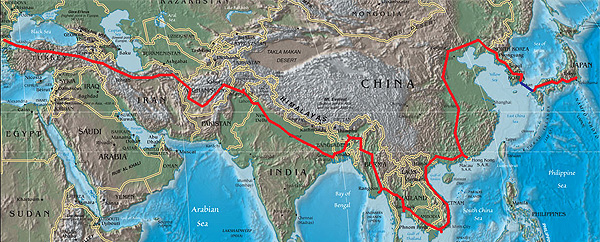
OBOR is a highway and Railway connectivity project envisaged to connect the Chinese mainland to Europe through Central Asian Republics (CAR) region. This is supposedly an economic initiative of China. Proposed in 2013, this route aims to replicate old Silk Route, once used for commerce between China and Europe with primary export from China being Silk. This ancient trading route is proposed to be recreated by building modern highway and railway network. There is a maritime silk route (sea trading route) also proposed as part of this initiative.


China touts OBOR as a sure recipe of growth and progress of the region. OBOR, as per the Chinese declaration is supposed to bring progress to the Central Asian Region and provide improved connectivity to China and CAR to Europe. Infrastructure and connectivity is definitely an issue in the CAR region. If google map is asked for a road route Between Almaty, Major Cultural and commercial city of Kazakhstan and Urumqi in resistive Xinjiang region, Google returns “ Sorry, we could not calculate driving direction from Almaty to Urumqi”. Connectivity from China to Europe exists through Russia but not through CAR, hence there is definitely a need for connectivity through this region.

The underlying reason for promoting OBOR as predicted by the experts is to create newer markets for Chinese Goods. The growth of Chinese goods sales has become stagnant elsewhere and thus China needs newer Markets. China needs avenues to sell its goods, an outlet to its engineering and infrastructure companies and jobs for its population. as the Chinese economic growth rate is down from its days of glory. The Chinese growth rate has fallen consistently and it has come down from 7.8 % per year in 2014 to 6.7 % in 2016 as seen from the graph below:-


OBOR seems to meet all the three needs mentioned in the previous paragraph. The OBOR initiative has been supported by all the nations of the region except India. Many strategic thinkers have been suggesting that India should join the initiative of OBOR else there is a fear of India being left out of the benefits of OBOR.

Before we pass a judgement on India’s stand with respect to OBOR, let us look at the business model of China in various nations where China is doing some development. Chinese development comes with their own money as a loan (that is how aid is provided by many countries including India), that is not unusual.  What is unusual is, the contract for that work goes to Chinese Company, the labour and engineers come from China, Material comes from China, even the insurance is also done by a Chinese company.

There are examples galore of this style of Chinese aid. What does it mean in real terms is, China gives by one hand and takes it away by the other hand, all the jabs, all the benefits of the business, everything goes to China. On top of it, the insurance cost and the interest on the given loan also goes to China.  The nation where the project is run by China gets just the plain infrastructure which that nation has to maintain and the scale of that infrastructure may be such that the poor nation supposedly being helped may either have little or no use of that infrastructure. The Chinese loan also has to be paid without earning anything as the earnings have all gone to China.

Hambantota port of Sri Lanka is the one such example. Sri Lanka borrowed heavily from China. The port was built in the same manner as explained above. The debt burden became so much on Sri Lanka that it had to hand over the port to China on a 99 years lease as repayment of the loan. To quote from CSIS Brief of 02 Apr 2018, In pursuit of that dream (of building Hambantota port), Sri Lanka relied on Chinese financing. But Sri Lanka could not repay those loans, and in 2017, it agreed to give China a controlling equity stake in the port and a 99-year lease for operating it. On the day of the handover, China’s official news Agency tweeted triumphantly, “Another milestone along the path of #BeltandRoad.”

There lies the trap that China has set for the nations of OBOR. Chinese strategy is simple, raise the dreams in the target nation. Make that nation borrow heavily from China, Syphon off all the money and additional profit back to China. Leave the nation with an infrastructure that it either does not need or even if it needs, it can not use and also huge debt burden. Finally, as a way out for settling the debt, takes control over that infrastructure form the host nation.

Coming to India’s reluctance to join OBOR initiative, the official stand is that China Pakistan Economic Corridor (CPEC, a part of OBOR initiative though not indicated in OBOR maps)  from China to Gwadar (a Chinese built port) in South West Pakistan, travels through Pakistan Occupied Kashmir (See the pink area indicating POK in the map below) which is a sovereign part of India. The OBOR initiative, therefore, infringes on the Indian Sovereignty. It’s a rightful stand for India to take.


Is the sovereignty infringement reason good enough to oppose the OBOR? Will India be left out of the benefits of this initiative if India does not join it? While many Indian thinkers are of the view that India stands to lose economic benefits if it does not join OBOR initiative, I do not agree with that view. Nation’s sovereignty is supreme. Apart from that, India's geopolitical interests do not always coincide with China. Also, OBOR initiative, if joined by India, will empower China to have total Hegemony in the region which is definitely against India’s interest.

It is not just India, OBOR does not find much favour from European Governments too. Many Europen governments do not consider OBOR a multilateral project, they consider it as a bilateral project between China and the concerned country.

Many nations of the South China Sea are already suffering the Chinese illegal hegemony and they look up to India as a counterweight to China. In days to come, OBOR nations, particularly CAR nations, when they will realise the debt trap disguised as the development of infrastructure, would turn to the only other similarly capable nation in this area, India. India is very much aware that sooner than later the CAR nations will look up to India. As such, India also maintains a very good relationship with CAR nations. The political ecosystem is fragile in CAR and China is the only major surviving communist government in the world. Chinese communist regime is stable at present but the future of this government cannot be predicted in the years to come.

It is important to note that there are many Indian initiatives in the CAR area for improved connectivity. India is a partner in the Asian Highway Project which is the connectivity Project between Europe and South Asia. Other nations partnering the project are Srilanka, Pakistan, Japan, Bangladesh, Nepal, Iran, South Korea and China with funding coming from India, Japan, China. South Korea and Taiwan. There is also a Trans Asian Railways project underway. Asian Highway project, in fact, covers many areas similar to OBOR. This also explains why India need not support OBOR. There are many roads that are planned to be built but the longest among them is Asian Highway 1 of over 20000 km, whose alignment is given below


“India – Myanmar – Thailand” Road and motor vehicle agreement is another such initiative. India also has a partnership in the “Connect Central Asia” project in which International North-South Corridor is envisaged for moving freight between India, Iran, Afghanistan, Armenia, Azerbaijan, Russia, Central Asia and Europe. Chabahar port in Iran is being developed by India to support the INSC initiative. There are other similar projects where India is deeply involved.


The Chinese intentions about objectives and plan for OBOR are secret even after 5 years. However, OBOR seems to be an act of gaining supremacy in CAR and that is where India’s interests clash with China. Since Inda already is either a promotor or partner in many such initiatives, India has no immediate requirement of joining or supporting OBOR. Even without getting involved in OBOR, India is well poised to have its rightful influence in CAR. As and when the CAR nations realise the Chinese game plan of dragging them in debt plan, transparent India would gain even more confidence of these nations.

 With all this, the question is not, “why is India not supporting OBOR”, the question really should be, “Does India need to support OBOR”? Going by the overall perspective of the OBOR initiative and Indian’s own plans which are similar to OBOR but with the more transparent regime, unlike OBOR, India does not stand to lose by not joining or supporting OBOR and should continue to maintain that stand till the factors around this (OBOR) initiatives change in such a manner that joining this initiative becomes beneficial to India’s interest, India may reconsider its decision.


Tuesday, February 13, 2018

India Post - nostalgia that it is

When we talk of India Post, first image that comes to our mind is that humble foot borne or cycle borne lovable figure (seen ourselves in our villages or shown in the movies) in his (those days there were only males in that job) Khaki uniform, lovingly (and also by his designation in the department) called "Postman"

Here was this character, who was lifeline to families of Soldiers posted to remote, unknown and unheard of places, Old parents whose children were working somewhere else in India, newly wed Brides who could spent barely few days with their husbands because he had to leave in search of a job, relatives who are anxious about the health of their near and dear ones in some other place and the list is endless.

There were others who were waiting for some one to tell them the news around their town, some waited for him to readout news paper for them (may be the postman was the only one who could read and write), some waited to ask the postman to write a reply to their son, husband, brother and who else for the letter they received some days ago (which also was delivered and read out by the same man).

People in the countryside might have waited for the Monsoon rain to arrive once in a year but they all waited for this vital character and a reliable one, their Postman, daily, for all 365 days (excepting Sundays).

The feeling in the town and cities has not been very different. Many a people achieved great sanctification when they sent a Money Order (New generation may not know about it and it might have been discontinued) back home and got the receipt as also letters written on a five paisa Post Card (Another thing along with Inland letter which young generation may not know) to inform them as to how they derived happiness by that meager money that was sent through Money Order.

The reliability and religiosity (Treating this job as a religion) in executing the task of delivering mail to people were (and even todate are) the hallmarks of India Post. Way back, when I was doing my BE at Bilaspur in MP (Now in CG), I have received letters where the address was just Harshad Datar, Bilaspur. It must be remembered that even those days Bilaspur was a big city.

When I asked the postman as to how such letters reach me, he explained that there are limited delivery zones in a city (Bilaspur had two, Rly Zone and CIty Zone). When a letter is received with incomplete address, all the postmen of the zone are asked if they have a person of that name in their beat. If the answer from one of the postman is yes, the letter is given to him. If the answer is no, the letter is transferred to another zone where this process is repeated. SOme postman in some zone recollects the name and delivers the letter, How wonderful.

Yet another time a letter posted by me with incomplete address (with out house no and lane no, left blank by mistake) for a Bandra East resident was still delivered. All this for a meager cost of two rupees (that w as the required postage for an envelop those days).

 Another great thing was, if any of the letter posted had less amount stamps then required, then it was termed Postage Due letter (and stamped accordingly) and was definitely delivered. The due amount was collected from the receiver. Such letters were termed "Berang" in Hindi. Knowing this habit or procedure of India Post, many a businesses intentionally posted their letters "Berang" i.e. with less postage stamps than required,, knowing fully well that due to postal procedures those letters would be definitely delivered.

There were some wonder employees of Posts. When I was at Defence Services Staff College, Wellington, Ooty, we had a postman, if I remember his name correctly, called Ranga. Every year about 400 hundred officers used to join. Each was allocated a locker number and within few days, Ranga knew each officer, his name and locker Number (all mail was delivered into the lockers). He did this years after years. I am not sure if he is still around, but this humble postman received praise and high respect from each of the officer attending staff course. Similar was the story in many bases where looking at your face the Postman would tell you if there is a letter for you or not.

Post Offices were old, dusty, run down, ramshackle but the service that they provided were first class, personalized, always delivered with smile and at very meager cost. They were just superb. The Nostalgia of the Post Office and its simple, sincere and  humble postmen who toiled each day serving all, rich and poor alike. Even other things like Post Office Saving Scheme were wonderful. Some poor people new only Post Office Saving Scheme as their first and mostly last bank.

Today post offices have somewhat modernized. Importance of the Snail Mail has diminished (not gone away), personal touch of postman (at least in big cities) is also somewhat reduced but India Post Nostalgia lingers on. What an Nostalgia India Post was an it continues to be.

May "Parmatma, Supreme Being" bless all those wonderful India Post Staffers who brought solace and happiness to millions, who shared peoples grief and consoled them, who were the hopes of millions and their only medium to be in touch with their near and dear ones who were far away for various reasons.

I love India Post and may they flourish with each passing day.